Day 3: Dialogue, Dialogue, Dialogue
- vidvry
- Jul 13, 2025
- 6 min read
Updated: Jul 14, 2025
June 3
"Dialogue, Dialogue, Dialogue" --former Taoiseach Bertie Ahern

This morning we woke up early and bussed down to Dublin to visit Áras an Uachtaráin (air-is ahn ook-ter-rahn) the residence of the Republican of Ireland's president. The drive from Newcastle to Dublin is about two hours, and I ended up sleeping much of the way down. I woke up as we were driving through Phoenix park, which we were told is one of the largest (if not the largest) urban parks in all of Europe, past a large zoo and lots of forested walking paths, before arriving at the gates of the residence. There were a surprising number of pedestrians strolling around despite the wet weather, but I guess when it rains every day you learn to get on with it.
We then drove past a high gate, down a deserted pathway, and right up to the front of the Irish version of the White House. There were no metal detectors to pass through and very little fanfare— I’d bet most American high schools require more checkpoints to enter. We wandered through lavish state rooms where we were served tiny sandwiches, pastries, and deliciously tart apple juice harvested right from the apple trees planted on the Áras' lawns.
Everyone seemed a little starstruck, but the staff were very friendly and laid-back, something that seems to be very typical of Irish people.


The Áras staff let us play the piano and even sit on the formal chairs, including a couch that used to belong to Marie Antoinette in Versailles(!) We took photos outside by the trees planted by JFK, Obama, and the third (but first American-born) president of Ireland, Éamon de Valera.
The aide de camp told us that it’s highly unusual, “getting a bit silly really,” that nobody has begun campaigning to be president yet, despite the elections happening in November. They speculate that Bertie Ahern, former Taoiseach (tee-shookh) might throw his hat in the ring, since he was prime minister during “the most successful time in Irish politics,” according to Dr. Tim. Now we get a chance to talk to him ourselves.

...
We met Bertie Ahern at a nice hotel in Dublin. He was a short, white-haired man with a rosy face and a large nose. He was wearing a black suit and greeted Dr. Tim by name, clasping his shoulder and embracing him warmly. Tim seems to know everybody personally, and apparently he has known "Bertie" (as he called him), from many years back. Indeed, Bertie sang Tim's praises, telling us how important his work is in bridging the divided communities of Northern Ireland. Bertie said some days Tim will be shaking hands with Sinn Féin politicians, the next with Orangemen, and when he's "in really rare form, he'll have both in the same room talking to one another." I was quite impressed by this account-- I hope to do similar work back home.
Bertie was full of gems. He began by telling us about his upbringing in Dublin before going on to detail his rise to leader of the center/center-right political party Fianna Fáil (feen-uh foil) and eventual tenure as prime minister. When he became Taoiseach in 1997, he helped negotiate an agreement between his government, the British government (headed by Labour Prime Minister Tony Blair), and the political parties of Northern Ireland, including members of Sinn Fein seen as the political arm of the Irish Republican Army (IRA). The "Good Friday Agreement," so-called in recognition of the Christian holy day on which it fall, ended the Troubles, and laid the framework for a lasting peace in Northern Ireland, which became Bertie's greatest legacy.
He had many choice lines when describing the work that went into building the peace, but some of my personal favorites were:
"I’m a great believer in dialogue. Dialogue helps at every level. It is about engagement, it’s the best way of doing it."
and
"If you play games with people, they catch you out. Listening I think is probably the biggest thing. Even if you have a natural inclination to say: ‘You're talking bullshit,’ you go in and try to listen."
Mostly he emphasized that the Good Friday Agreements were not perfect, but by and large its conditions made things better for the people, safer and more stable.
Tim chimed in at this point, telling us that when he was growing up, he "never thought there would be peace in Northern Ireland. Never." He told us that when he visited England for the first time as a young man, he was shocked to realize that he was the only one raising his hands after stepping into a Boots pharmacy. Tim was so used to the violence of home that he didn't realize how abnormal it was to expect to be searched for weapons.
He emphasized the fear of that time, the undercurrent of it. Tim told us that he came from a Protestant household, and only knew other Protestants growing up. Once as a young man he and his friends went down to Dublin for a concert. He recalled how nervous he had been; he told us how his group rehearsed parts of the Irish national anthem ahead of time in case concertgoers would be able to sniff them out as "British" due to their ignorance of the Irish language.
Bertie nodded at this, and said what a long way they've come since then:
“There’s an old Irish saying: stop someone in the countryside and ask how you get where you’re going, they'll reply, ‘Oh gee, if I was trying to get there, I wouldn’t start from here!'” But you have to start somewhere.


...
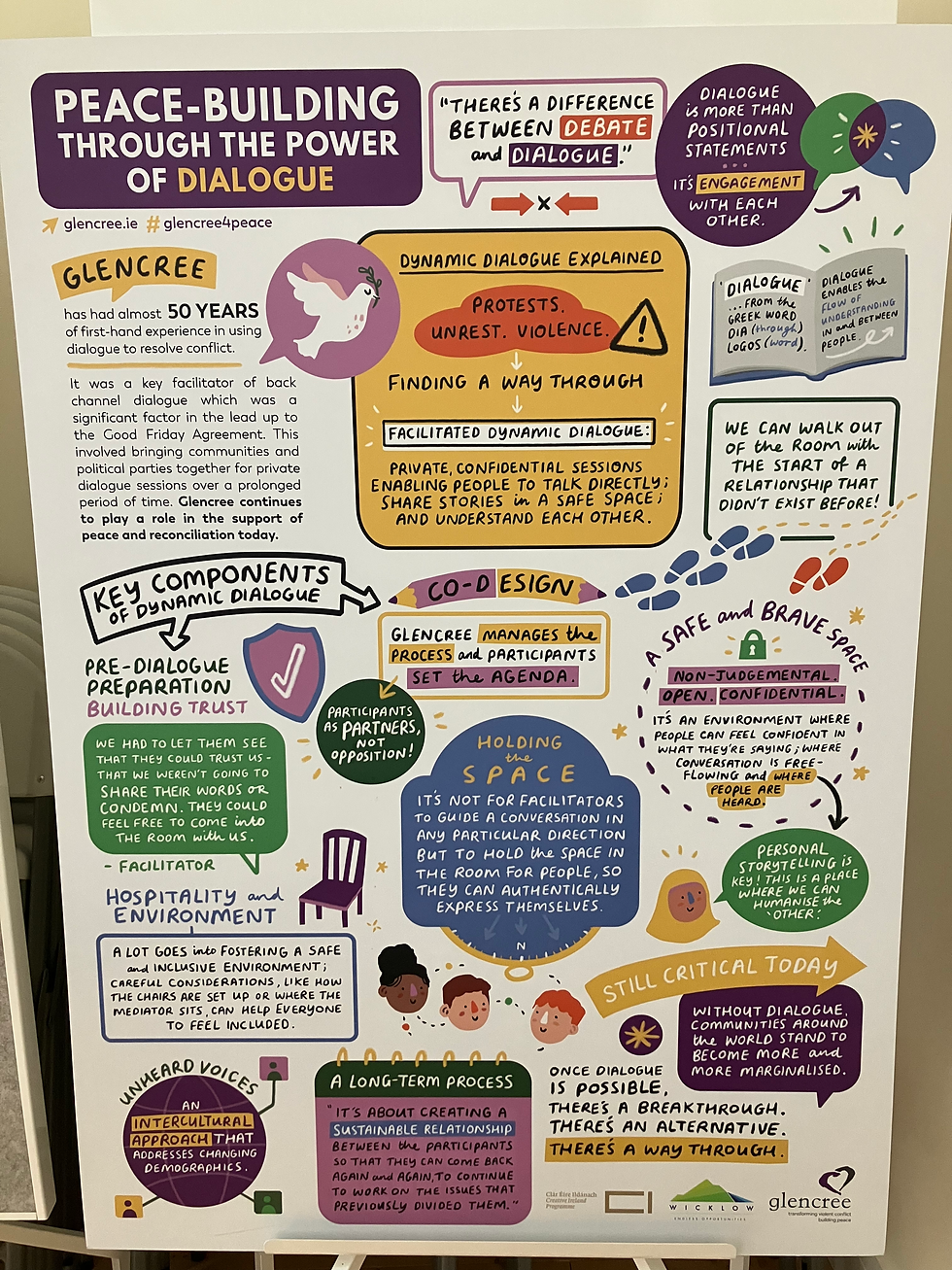
After wrapping up with Bertie, we drove out through the Wicklow Hills, passing Sugarloaf Mountain in the distance. It was beautiful, green and hilly, and I had a perfect view as we made it over the border of County Dublin and into County Wicklow, to the Glencree Centre for Peace and Reconciliation. Glencree was once a military barracks, and looked like a stone castle nestled in the mountains we had seen driving up.
Led by former special advisor to Bertie Ahern, Pat Hynes, the Glencree Centre was born out of the negotiation work that went into the Good Friday Agreement. As a young Fianna Fáil politician, Pat was sent by Bertie to Glencree to begin to facilitate secret talks between the paramilitary and political groups involved in the Troubles. Pat told us that he was originally an economist, and confessed he was confused and disappointed when Bertie assigned him the mediation task: "You want me to do what?" But it was clear to see why Bertie had chosen him.
Soft-spoken but composed, Pat's explanations were both straightforward, clear, and yet also full of beautiful allegory. After the Young Ambassadors introduced ourselves and told him all the parts of North America we came from (Toronto, Florida, Pittsburgh, Wisconsin), he leaned back and said simply:
“Immigration is the mirror by which Ireland sees its true face.”
What poetry! And when describing Northern Ireland, he touched again on the proxy wars described by Eamonn back in County Down. He echoed Eamonn's sentiments, saying of the Irish,
"We're a people acquainted with grief and loss."
He went on to outline his experience working with conflict-riven peoples, saying that "we had to learn a new language," when speaking to those who were living through the North's violence. The important thing about dialogue work, however, was that it did not shy away from or gloss over deep disagreement. He said, “Everyone brings their own baseball bat, but lay it by their feet. Authenticity of expression is important." So much of the problem with dialogue work, I think, is that it tries to emphasize commonality at the expense of profundity. If you stay on the surface, you can create a false sense of unity. But when there is real disagreement, acknowledging it is more honest, and can lead to a more genuine accord. Of course, talking about difference can also lead to a much deeper fissure. But I felt so encouraged by the quiet power of Glencree.
I'm reflecting most on Pat's final words: "It's not what you can gouge out from your opponent, it's what you can compromise and reflect on in yourself." Eamonn said something so similar yesterday, though his words had a much different resonance: "It's not the people who can inflict the most pain who win, it's the people who can take the most pain."


Comments