Day 2: Down to Downpatrick
- vidvry
- Jul 9, 2025
- 5 min read
Updated: Jul 14, 2025
June 2
When Eamonn McGrady was a child in Downpatrick, there were 40 kids in his primary school class. The year was 1968, and Downpatrick was a pretty quiet village a little less than an hour southeast of Belfast. By the next fall, Eamonn told us today, his class had 90 children. The Troubles had begun, and so many houses were “getting burnt out” in Belfast that families moved out by the hundreds and spread to more rural areas like Downpatrick.
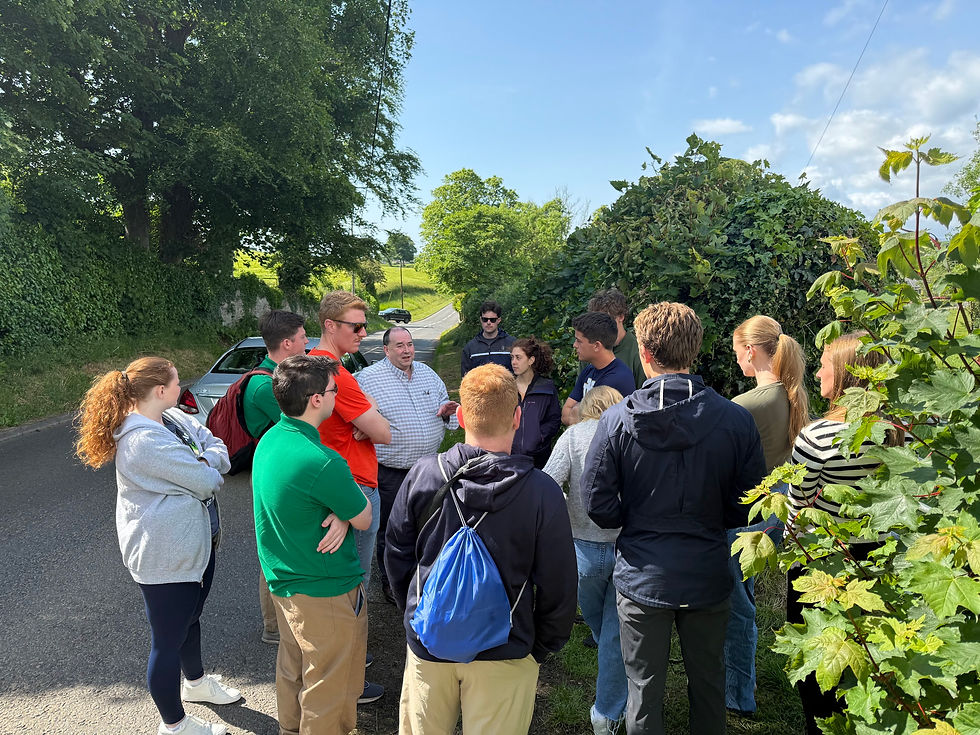
Today was the first time I’ve heard the Troubles referenced like this, both casually and with a certain gravity, by someone who lived through them. It was toward the end of the day when he told us; we were standing as a group in front of a low stone wall that encircled the Struell Wells, and everyone seemed to lean in and focus more intently at the intimation of violence.
…

This morning was the first time we met Eamonn, along with another member of the board of the Saint Patrick Centre, Emma Killen, both of whom then told us a bit about their work with the Centre and in the broader community. Eamonn works as an accountant and Emma is a solicitor– both gave the impression of being down-to-earth and unpretentious people despite clearly being fixtures in the community. They smiled and invited questions openly, and Eamonn then took us on a tour of the area, making several stops and hardly pausing for breath for the amount of information he had to share.
Eamonn told us some demographic statistics about the county, Down, which is 87% Christian, 80% of whom identify as “practicing.” Of the Christians, 54% are Protestant, 33% are Catholic, and 13% identify as having "no religion." 97% of the inhabitants are white. There is 29% unemployment here, a relatively high number, and according to him the health care infrastructure is underfunded and lacking. He mentioned a struggle for resources at the local hospital, which apparently just had its emergency department shut down.
You could tell by the way he spoke and the wealth of information he had about Down that he’s not only a life-long inhabitant of the community but also passionately invested in its wellbeing and future. That isn’t to say he was overly serious, though. One of the ambassadors told me later that at the end of one of his spiels, he winked at her and said, “Do ye want to kill yourself yet?”
We first stopped at the local racetrack, Downpatrick Racecourse, which has a hilly track that ends in an incline, unlike most American racetracks which are primarily flat. Eamonn told us that the forelegs of racehorses are slightly shorter than the back-legs, which means varied tracks are actually more comfortable for them and can lead to some great photo finishes.
We took turns in Eamonn’s car, and I was lucky enough to take the first turn along with Connor, Elliott and Jersey Mike (nicknamed for his hometown + the popular sub sandwich chain). That’s when Eamonn began telling us about his childhood in Downpatrick, and its lasting impacts on Northern Ireland’s politics and culture. I saw a newspaper lying in the footwell of the passenger seat with a front-page headline blaring the horrifically high death toll in Gaza, and we began talking a bit about the current violence there.
He told me that in Northern Ireland, Republicans (which largely overlaps with Catholics) tend to embrace the Palestinian cause: “Because of Irish history we tend to identify with the smaller nations and oppressed peoples of the world.” As he spoke, he kept his eyes on the road and drove with a calm certainty, he clearly didn’t need to consult road signs or GPS. Eamonn said that in Northern Ireland “we manage to divide along sectarian lines” in every conflict. So for instance, when one side (Republican, Catholic, Irish/North of Ireland-ish?) puts up a Palestinian flag, the other side (Unionist, Protestant, Northern Irish/British?) looks at it and says to themselves, ‘I guess we need to find an Israeli flag.’
They operate with an extreme logic of ‘the enemy of my enemy is my friend,’ even to the point of comedy, with conflicts that seem wholly unrelated to Northern Ireland, but more on that in a later post.
On a second look, I noticed that the newspaper Eamonn was reading was called the “Irish Republican News.” I thought about how much our milieus impact us. Our parent’s views, our religions, our schooling, our social class, our news sources. The water we swim in.
Ironically, the way Eamonn described the Irish to explain their affinity with Palestinians reminded me of the story I was brought up with, the story of the Jews, some of whom eventually became Israelis. That story says: we are a tiny nation, an oft-oppressed and suffering people with a right to the land on which we live. But that story is the story of others who live there, too. I digress.
…

Next we walked to the Ballynoe Stone Circle, an ancient grouping of stones arranged 3000 years before the Egyptian pyramids were built. Apparently seven bodies were buried in the middle, which would have been a pagan custom. It was a beautiful spot, and the weather was perfect– sunny and mild. The path leading there was completely wooded, and people had placed plastic and felt miniature homes to suggest fairies lived there.
I was taught not to walk on burial mounds: in Judaism one isn’t supposed to. But this felt less of a man-made burial place and more of an amazing natural site. Grassy and sunny, with a slight breeze and horses in the distance, it had a secret, magical feel to it.
After Ballynoe we made a quick pitstop at St. John’s Lighthouse and Church in Lecale. We walked down to the edge of the water and ate some nice chocolate bars and chips courtesy of Eamonn.

We then drove to Ardglass for lunch, but stopped briefly at a little old church called the Star of the Sea, where I found a tiny animal bone (you can see it in my hands in the picture). The church was empty and silent, and many of the other ambassadors knelt to say a prayer.


I started to drag at this point– fatigue was hitting and the weather was overcast, but we got back on to the bus in order to hit a few more destinations: Ballyhornan where we saw a WWII base, Gun Island and the bay. We competed against one another in a rocking throwing contest on the beach, which Christian, a member of House Malachy (woohoo!) won.
The last stop of the day was the Struell Wells, a group of four pre-Christian stone wells. Pagans used to make pilgrimage to wash their eyes and bodies in the holy well-water there, and even today some do rituals there, though Tim advised us jokingly not to wash our eyes there now, since the water is stagnant and foul.
At the end of the visit, we gathered for a last talk by Eamonn. He talked about the violence of his childhood and the conditions of peace that make this place “so much better now.” He echoed a sentiment Tim told us the day before, that Saint Patrick is not a divisive figure. “Was he a Protestant or was he a Catholic? He was neither because neither existed yet.” He implied that as part of the path to forging a new identity in the era after the Troubles, Patrick can serve as a powerful uniting symbol. This is the idea behind many of Tim’s efforts at the Saint Patrick Center, the work he does to educate about history and build bridges across difference.
Nobody has a monopoly on truth, Eamonn said. This is one of my guiding principles.


Comments